:sales@zsjhsteel.com WhatsApp:+86-15122582058


Views: 0 Author: Site Editor Publish Time: 2026-09-20 Origin: Site


Choosing a structural steel fabrication company is not simply a matter of comparing price per ton. For industrial buildings, heavy steel structures, equipment frames, platforms, bridges, warehouses, and custom fabricated components, the fabricator’s quality system, production capability, inspection process, delivery performance, and engineering support can directly affect project cost, schedule, erection efficiency, and long-term reliability.
Before placing an order, buyers should first confirm the basic compliance requirements for the project, then evaluate the factory’s real manufacturing capability. The following six areas provide a practical framework for supplier qualification.
Start by defining which qualifications are actually required by the project location, contract, design code, and scope of work. For projects involving fabrication only, the relevant requirements may differ from those for on-site erection or general contracting.
For China-based projects, buyers may need to review applicable construction enterprise qualifications and safety-related permits when the supplier’s scope includes construction or erection. For export projects, ask the fabricator to provide certificates relevant to the destination market and the project specification rather than relying on a generic list of certificates.
Common examples include ISO quality, environmental, and occupational health and safety management systems; AISC certification for projects that specify it in the United States; CWB certification for applicable welded fabrication in Canada; and EN 1090 / CE-related conformity requirements for structural metallic products within the relevant European regulatory scope.
Buyer tip: request the certificate number, certified facility address, scope, standard, issuing body, and validity period. Verify that the certification covers the actual factory that will manufacture your order. |
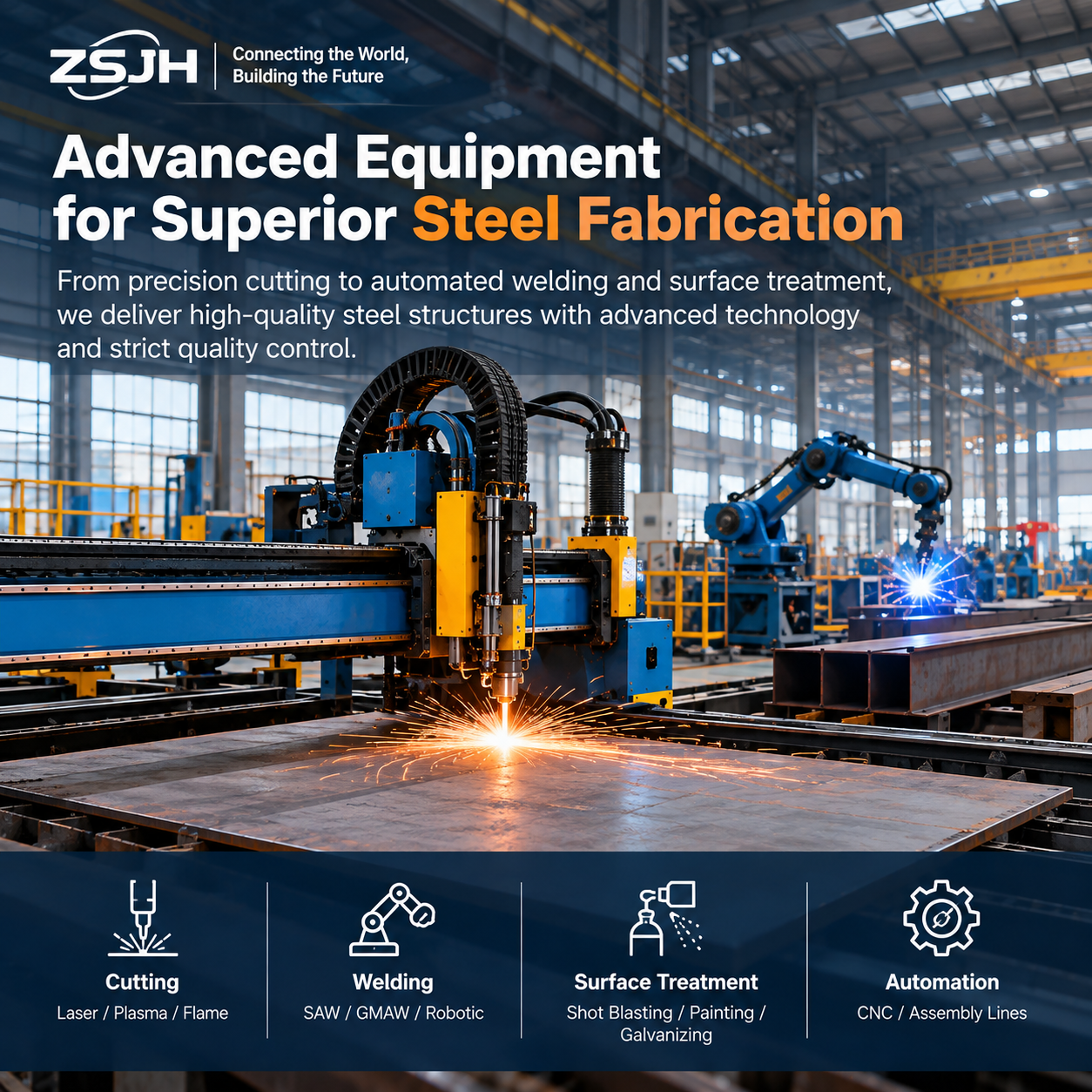
A factory visit—on-site or by live video—is one of the most effective ways to understand whether a supplier can consistently manufacture the components shown on your drawings. Equipment alone does not guarantee quality, but suitable machinery, maintained production lines, qualified operators, and controlled procedures provide the foundation for repeatable fabrication.
Process | Typical Capability | What to Check |
Cutting | CNC flame, plasma, laser, or other suitable cutting systems | Plate thickness range, nesting, edge quality, dimensional control |
Assembly | H-beam/box-section assembly and fit-up equipment, jigs and fixtures | Repeatability, alignment, tack-welding control |
Welding | SAW, GMAW/FCAW, welding manipulators or robotic stations where suitable | WPS/WPQR or equivalent procedures, welder qualifications, heat/input control |
Drilling & machining | CNC drilling, punching, milling or machining as required | Hole location, bolt-group accuracy, traceability |
Surface treatment | Shot blasting, painting/coating lines; galvanizing through qualified process route | Surface preparation grade, DFT control, coating system |
Handling | Cranes, turning devices, lifting fixtures and loading equipment | Maximum member size/weight and safe handling |
For complex or repetitive components, higher levels of automation can improve consistency, but the key question is whether the equipment matches your component geometry, tolerances, steel grade, plate thickness, welding volume, and production quantity.
A supplier may have strong technical capability but still be the wrong choice if its production schedule cannot support your project. Ask for evidence of available capacity instead of relying only on a stated monthly tonnage.
Useful questions include: What is the factory’s normal and peak monthly output? How many cutting, assembly, welding, blasting, and coating lines are available? What is the current production load? What is the maximum single-member size and weight? How much material can be processed per shift? How are urgent orders handled?
For large projects, request a preliminary production plan linked to drawing approval, material procurement, fabrication, inspection, coating, packing, container loading or break-bulk shipment, and phased delivery. Capacity should be evaluated against your required shipment dates, not as an isolated factory number.
Do not accept a single universal tolerance value for every structural steel component. Required tolerances should come from the project drawings, contract specification, applicable fabrication standard, and approved inspection plan.
Ask the fabricator to demonstrate how it controls cutting dimensions, hole position and diameter, member length, flange/web geometry, straightness, squareness, camber, fit-up, weld size, and final assembly dimensions. Where the project requires tight laser-cut tolerances—for example, ±0.5 mm on specified parts—make sure that requirement is written into the drawing and inspection criteria rather than assumed.
The quality plan should also define material traceability, incoming inspection, welding inspection, dimensional inspection, non-destructive testing (such as UT or MT where specified), surface preparation, coating dry-film thickness, final inspection, nonconformance control, and document retention.
Buyer tip: ask for a sample Material Test Certificate, dimensional inspection report, NDT report, coating report, and final packing list from a comparable project. The format and completeness of these records often reveal how mature the supplier’s quality system is. |
A capable supplier should be able to show more than equipment photographs. Review projects that are similar to yours in structure type, member size, steel grade, tonnage, welding complexity, coating system, inspection level, and export destination.
Ask who will review drawings, prepare shop details, manage welding procedures, perform QC, coordinate production, and communicate technical queries. For welding, lifting, NDT, and other regulated or special operations, verify the qualifications required by the project and local rules.
During project review, pay attention to how the team handles drawing conflicts, connection details, tolerance accumulation, transport limitations, trial assembly requirements, marking systems, and erection sequence. These issues often determine whether fabricated steel arrives on site ready for efficient installation.
The lowest fabrication quotation may not deliver the lowest total project cost. A supplier that can coordinate detailing, fabrication, surface treatment, packing, logistics, and installation support can reduce interface risk and communication time.
For building projects, confirm whether the supplier can support secondary steel, purlins, bracing, stairs, platforms, roofing and wall systems, doors/windows, fasteners, and other accessories when required. For custom industrial steelwork, clarify whether the supplier can work from your drawings/BOM, assist with shop drawings, optimize member segmentation for transport, and provide assembly marks and installation guidance.
Before signing the contract, define the after-sales response process, treatment of nonconforming parts, replacement responsibilities, documentation package, installation technical support, and communication window after delivery.
Area | Evaluation Point | Recommended Evidence |
Compliance | Required certificates/qualifications match project scope and destination | Certificate copies + online/issuer verification |
Factory | Equipment fits member size, thickness, process and volume | Factory audit/video + equipment list |
Capacity | Available production window supports required shipment dates | Production schedule + capacity evidence |
Quality | Documented inspection and traceability system | ITP/QCP + sample reports |
Experience | Comparable projects and qualified technical personnel | Case studies + team/qualification records |
Service | Drawing support, packaging, logistics and installation coordination | Defined scope + deliverables + response process |
To receive a meaningful quotation, provide as much project information as possible: drawings and BOM, steel grade, quantities or tonnage, applicable fabrication and welding standards, inspection/NDT requirements, coating or galvanizing system, delivery destination, packing/container-loading requirements, erection or installation requirements, and target project schedule.
Clear input at the RFQ stage allows the supplier to evaluate material, welding, machining, coating, logistics, and production capacity accurately—and reduces later changes.
Located in Tianjin, China, ZSJH Steel supports steel structure projects with integrated services covering design coordination, customization, fabrication, surface treatment, delivery coordination, and construction/installation support according to the agreed project scope. As an EPC-oriented steel structure service provider, ZSJH works with customers from early technical communication through manufacturing and project delivery.
If you are evaluating a structural steel fabrication partner, send ZSJH your drawings, BOM, steel grade, quantity, welding and inspection requirements, coating system, delivery location, packing requirements, and target schedule. Our team can review the project requirements and discuss a suitable fabrication and delivery solution.