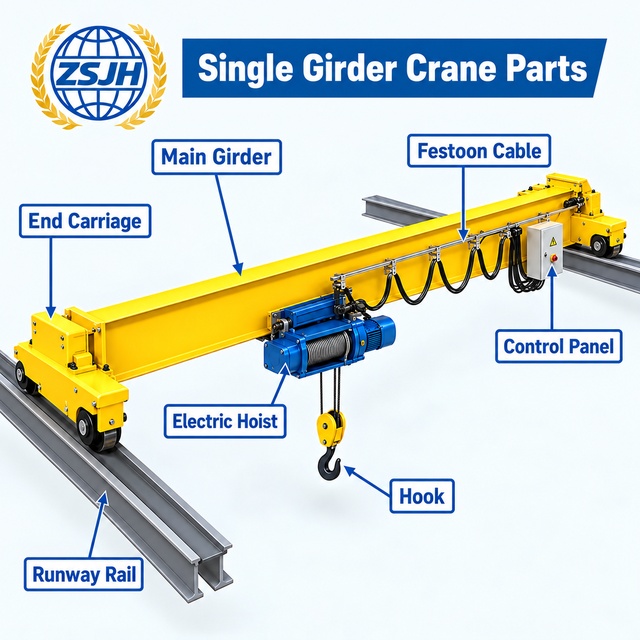
How the Structure Works
This is a top running bridge crane. Its end carriages travel on rails above the runway beams, while the hoist or lifting trolley provides cross travel and lifting. The bridge belongs to the crane; the building runway beams are supporting structures with a separately agreed supply scope.
Configuration Guide
Item | Enquiry and selection guidance |
Capacity | Example enquiries: 1, 2, 3.2, 5, 10, 16 and 20t; confirm the actual capacity/span/duty combination |
Span and travel | Specify rail center distance and required travel length, not building width alone |
Lift and coverage | Define upper/lower hook positions, approach limits, end zones and rigging height |
Crane duty | A3–A5 may be a discussion starting point; higher-duty tasks require specific review |
Drives | Electric hoisting, cross travel and bridge travel; speed or inverter options by equipment |
Controls | Discuss pendant or radio control; cab and automation need separate evaluation |
Power and environment | Confirm voltage, frequency, power feed, temperature, humidity, dust and corrosion |
Protection | Agree overload limitation, limits, emergency stop, braking and required anti-collision features |
Building data | Deadweight, wheel arrangement, maximum/minimum wheel loads, horizontal actions
and clearances |
Suitable Applications
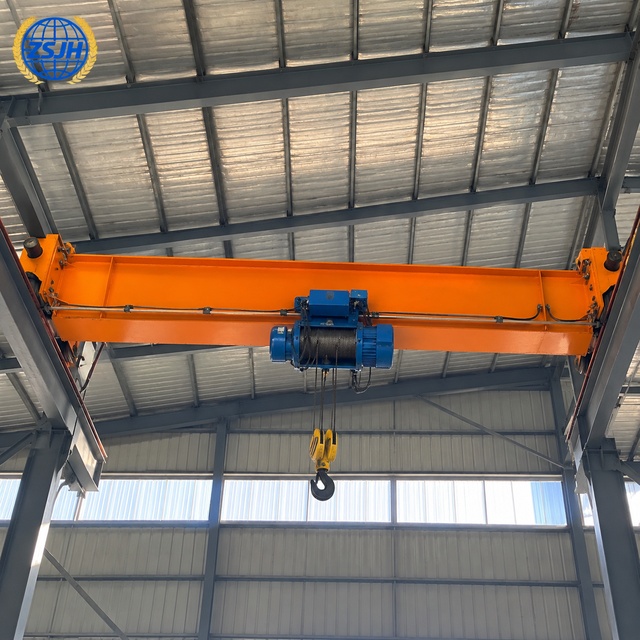
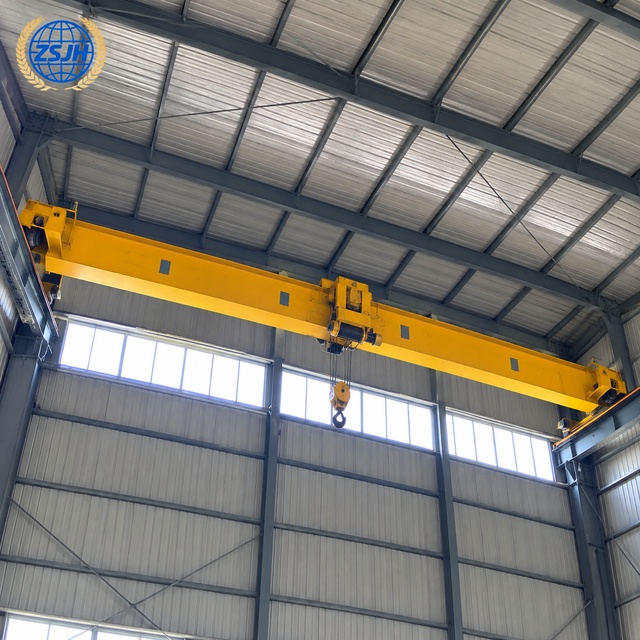
Consider this configuration for general fabrication workshops, warehouses, assembly areas, maintenance bays and appropriately designed PEB buildings. A suitable hook and rigging arrangement can handle many fabricated components.
For frequent heavy loads, larger spans or different hook-height requirements, compare a double girder solution. Some single girder configurations offer lower deadweight and wheel loads for the same task, but building and foundation costs require actual equipment data.
Understanding A1 to A8
Duty depends on intended service over the design life, including working cycles and the distribution of loads. Shift duration alone is insufficient.
Broad discussion group | Information to provide |
A1–A3 | Lower-intensity tasks, standby use and actual load distribution |
A4–A5 | General working patterns, lifts per day and full-load proportion |
A6–A7 | Intensive cycles, heavier load distribution and fatigue requirements |
A8 | Very intensive service requiring a specifically verified design |
These groups help describe the task; they do not assign a class by industry. Confirm crane and hoist/mechanism ratings separately. GB, ISO, FEM and CMAA labels are not automatic equivalents.
Choosing Controls
Radio control may suit changing operator positions; pendant control may suit a defined work area. Select inverter drives, fine positioning or sway-control functions against the task and available system. Radio control alone does not provide automatic sway control.
Attachments and Special Conditions
Option | What must be confirmed |
Hook and rigging | Suitable ratings, load balance and attachment method |
Magnet or special gripper | Attachment weight, workpiece properties, power-loss protection and system compatibility |
Grab | Hoisting/opening arrangement, total lifted load and duty |
Hazardous area | Area classification, gas/dust and temperature requirements, equipment and certificate scope |
Metallurgical or hot service | Dedicated review; an ordinary workshop crane is not specified for molten metal |
Choose Around Your Load and Building
1.Provide the heaviest load, dimensions, center of gravity, lifting route and attachment weight. Confirm the capacity definition with the supplier, including applicable removable lifting attachments and rigging.
2.Share building plans, sections, rail elevation and obstructions. New supports must be designed using crane reactions. Existing runway beams, columns, connections, bracing and foundations need appropriate structural assessment.
3.Then describe typical loads, lifts per day, shifts and positioning needs to establish duty and controls.
Frequently Asked Questions
Is 10t enough information for a quote? Also provide span, lift, travel, duty, power, controls and building conditions.
Does a hoist below the bridge make it underhung? No. Top running or underhung describes how the bridge travels on the runway.
Is A5 suitable for every steel workshop? Select duty for the actual task and load spectrum, not lifting capacity alone.
Coordinate Your Crane Package
Discuss requirements review, equipment and building interfaces, technical scope, separate equipment/support pricing, agreed inspection, export packing and installation documents. Define site erection, testing, acceptance, training and maintenance in the order.
Primary CTA: Get Your Single Girder Crane Quotation
Contact: sales@zsjhsteel.com | WhatsApp +86 151 2258 2058
Specification note: Capacities and options are enquiry guidance. Confirm performance, duty, protective features and supply scope in the agreed technical specification.

 English
 العربية
 Français
 Русский
 Español
 Português
 Deutsch
 italiano
 日本語
 한국어
 Nederlands
 Tiếng Việt
 ไทย
 Polski
 Türkçe
 አማርኛ
 ພາສາລາວ
 ភាសាខ្មែរ
 Bahasa Melayu
 ဗမာစာ
 தமிழ்
 Filipino
 Bahasa Indonesia
 magyar
 Română
 Čeština
 қазақ
 हिन्दी
 فارسی
 Kiswahili
 اردو
 Gaeilge
 Māori
 Hausa
 Igbo
 Kurdî
 Lëtzebuergesch
 ਪੰਜਾਬੀ
 Runasimi
 Yorùbá
 isiZulu


