:sales@zsjhsteel.com WhatsApp:+86-15122582058


ZSJH


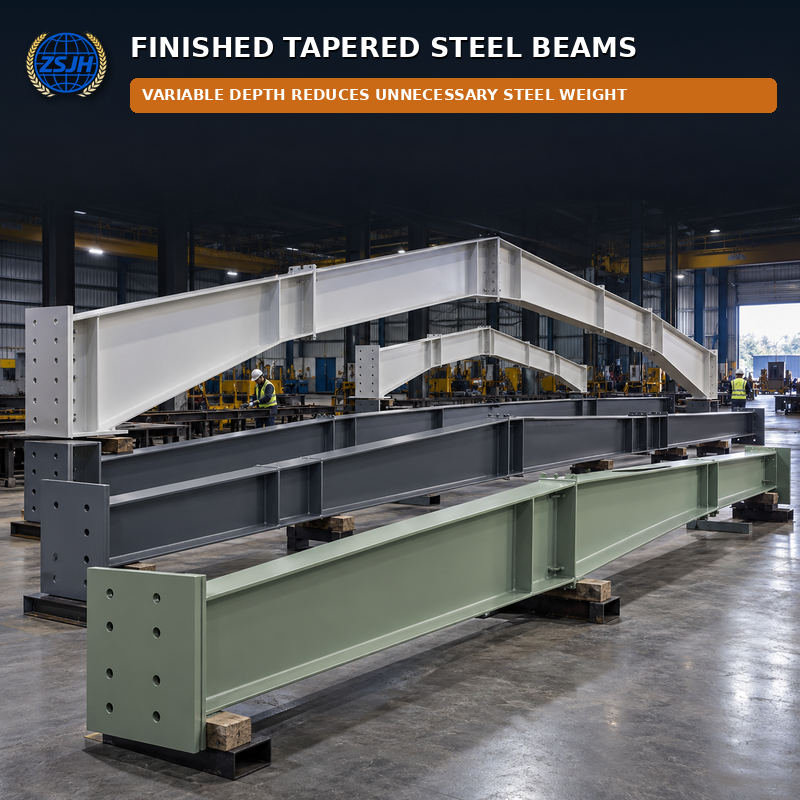
Custom Tapered Steel Beams are fabricated members whose depth changes along the length to match structural demand or architectural geometry. They are widely used as portal-frame rafters and columns, where deeper zones are placed near high-moment connections and shallower zones reduce weight in lower-demand regions.
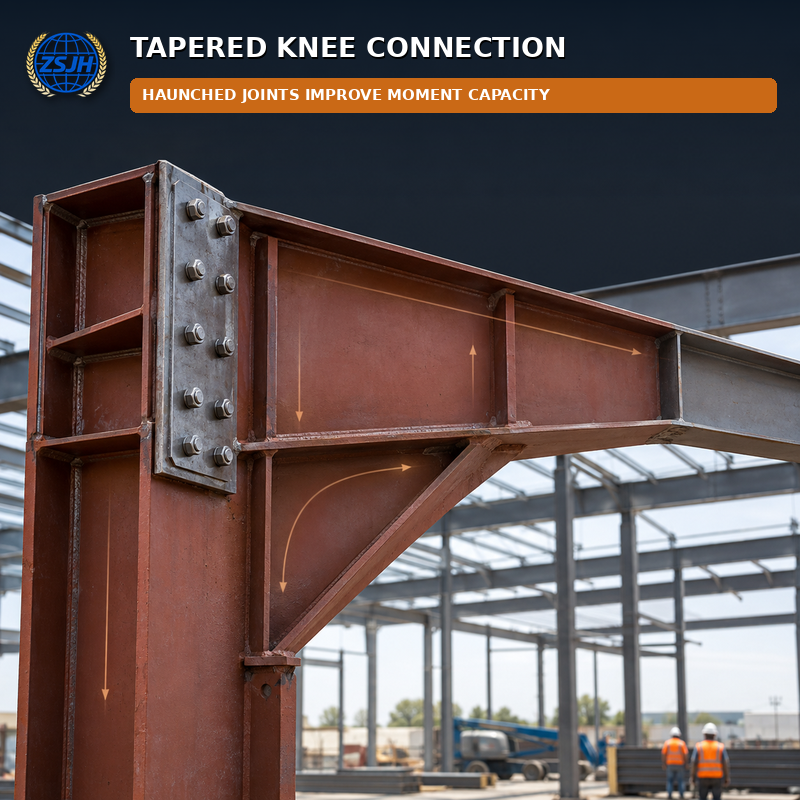
ZSJH Steel manufactures single-taper, double-taper, haunched and segmented variable-depth beams from cut web plates and flange plates. End plates, knee connections, apex splices, stiffeners, cleats and service openings can be integrated in the shop. Accurate control of taper, centerline, flange orientation and connection angles supports fast erection and consistent roof or wall lines.
Item | Available Options |
Profile | Single taper, double taper, haunched or stepped |
Section | Welded I/H section with symmetric or asymmetric flanges |
Use | Portal rafters, tapered columns, canopies and long-span framing |
Connections | Knee, apex, eave, base and field-splice assemblies |
Geometry | Depth, slope, angle, camber and length to approved drawings |
Welding | Automated longitudinal welds and manual attachment welds |
Finish | Blast, primer, paint or specified protective system |
Inspection | Taper, sweep, camber, hole pattern, weld and coating checks |
• Variable depth places material where structural demand is greatest.
• Lower self-weight can improve transport and erection efficiency.
• Suitable for portal frames and projects with sloped geometry.
• Shop-fitted knee, apex and eave connections support rapid assembly.
• CNC-cut tapered webs provide repeatable profiles across a building package.
• Piece and match marking simplifies frame-by-frame installation.
Industrial workshops; warehouses; agricultural buildings; aircraft hangars; logistics centers; sports and exhibition halls; canopies; portal-frame extensions.
We customize minimum and maximum depth, taper ratio, slope, flange dimensions, haunch length, web stiffeners, end plates, knee and apex details, holes, camber, shipping splices and coating. Members can be grouped into repeated frame sets while preserving unique piece marks for each grid location.
1. Review frame geometry, taper coordinates and connection angles.
2. Nest and CNC cut tapered webs and flange components.
3. Assemble the variable-depth section against controlled datums.
4. Weld longitudinal seams with planned sequence and restraint.
5. Install haunches, end plates, stiffeners, cleats and splice details.
6. Straighten while preserving specified taper and camber.
7. Inspect overall length, depth points, sweep, angles and hole pattern.
8. Blast, coat, mark by frame/grid and pack to erection sequence.
Tapered members are nested or supported to protect narrow ends, connection plates and coating. Frame-set packing and match marks help contractors identify columns, rafters and apex segments. Long members may be divided at approved splices to suit container or road transport.
What is the advantage of a tapered beam?
Its depth can follow the structural demand, often reducing unnecessary steel while providing greater depth near highly stressed connections.
Can tapered beams include portal-frame knee and apex connections?
Yes. End plates, haunches, stiffeners and bolt holes can be shop-fabricated from coordinated frame drawings.
Can you manufacture repeated frame sets?
Yes. CNC profiles and production fixtures support repeatability, while each member retains its project piece mark.
Send your portal-frame or tapered-member drawings for geometry verification, fabrication planning and quotation.


