:sales@zsjhsteel.com WhatsApp:+86-15122582058


ZSJH


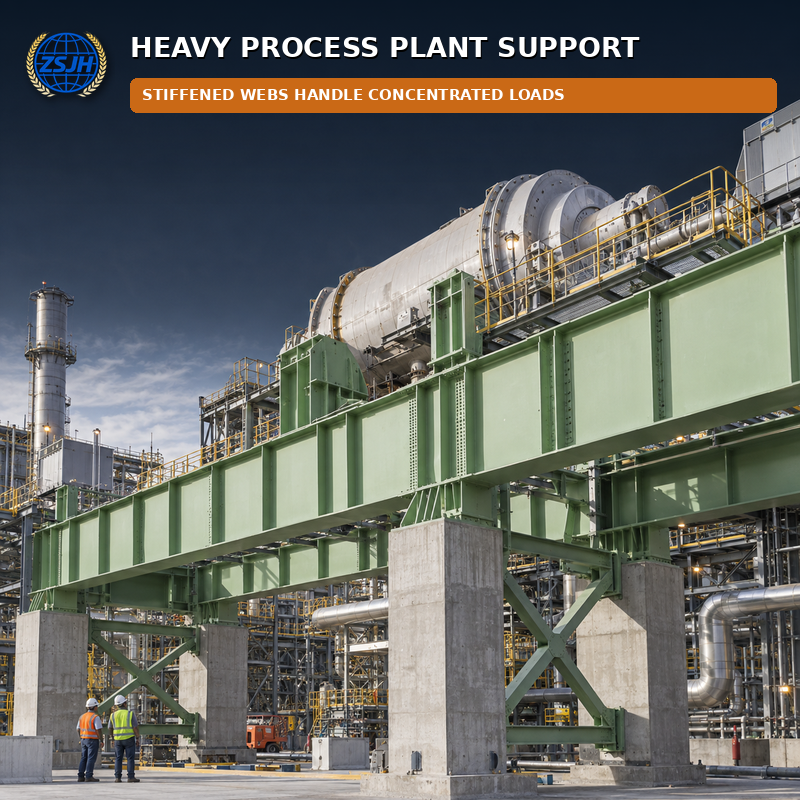
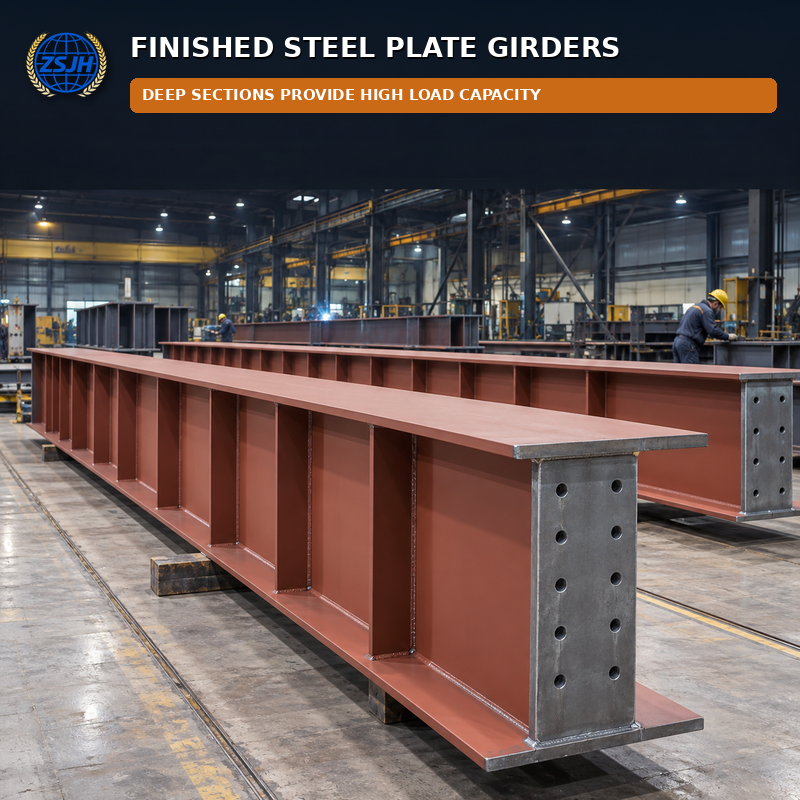
Welded Steel Plate Girders are deep primary beams fabricated from separate web and flange plates. They are used when required span, loading or depth exceeds the efficient range of common rolled sections. The web carries substantial shear while the flanges resist bending; transverse or longitudinal stiffeners, bearing plates and diaphragms can be added to stabilize the web and transfer concentrated forces.
ZSJH Steel manufactures plate girders for industrial buildings, crane-support structures, large roofs, transfer frames, galleries and selected infrastructure applications. Fabrication follows approved drawings and project standards, with control of web alignment, flange straightness, weld continuity, camber, bearing interfaces and splice geometry.
Item | Available Options |
Girder Type | Constant-depth, variable-depth or locally reinforced |
Web | Solid plate with transverse/longitudinal stiffeners as designed |
Flanges | Equal, unequal or varying plate thickness/width |
Splices | Shop welded, bolted field splice or combined |
Camber | Natural, heat-corrected or fabricated to drawing requirement |
Weld Inspection | VT plus UT/MT/PT where specified |
Surface Protection | Blast and primer, paint system or project coating |
Standards | Project-specified fabrication, welding and inspection standards |
• Deep custom webs enable efficient solutions for long spans and heavy loads.
• Flange dimensions can vary along the girder to respond to bending demand.
• Stiffeners and bearing details manage shear buckling and concentrated loads.
• Engineered camber can support specified erection and service geometry.
• Shop-controlled splices and connection details improve site fit-up.
• Inspection can be aligned with critical weld categories and project ITPs.
Large-span roofs; industrial transfer girders; crane-support frames; conveyor galleries; power plants; process facilities; heavy mezzanines; selected bridge or infrastructure components subject to applicable qualification.
Options include girder depth, web thickness, flange size and transitions, stiffener arrangement, bearing plates, diaphragms, access holes, web openings, camber, splice locations, connection geometry and coating. Transport envelope and erection sequence are reviewed early because plate girders are often long and deep.
1. Review plate optimization, weld categories, camber and splice details.
2. Trace materials and cut web/flange plates with controlled edge quality.
3. Prepare butt joints and complete plate splicing where required.
4. Assemble web and flanges on calibrated fixtures.
5. Weld main seams with balanced sequence and distortion monitoring.
6. Install stiffeners, bearing plates, diaphragms and end connections.
7. Verify depth, sweep, camber, flange alignment, holes and interfaces.
8. Perform specified NDT, surface preparation, coating and release inspection.
Transport cradles, lifting points and temporary bracing can be designed around the girder geometry. Contact surfaces and prepared field splices are protected. Piece marks and match marks identify mating members and speed site assembly.
When should a plate girder be used instead of a rolled beam?
It is typically selected when the required depth, span, loading or variation in section cannot be efficiently met by a standard rolled profile.
Can the flange thickness change along the girder?
Yes, where the structural design and approved splice or transition details permit it.
Do you provide NDT reports?
Specified VT, UT, MT or PT records can be included in the project documentation package.
Submit your girder drawings, weld categories and inspection plan for a fabrication review and quotation.


