:sales@zsjhsteel.com WhatsApp:+86-15122582058


ZSJH


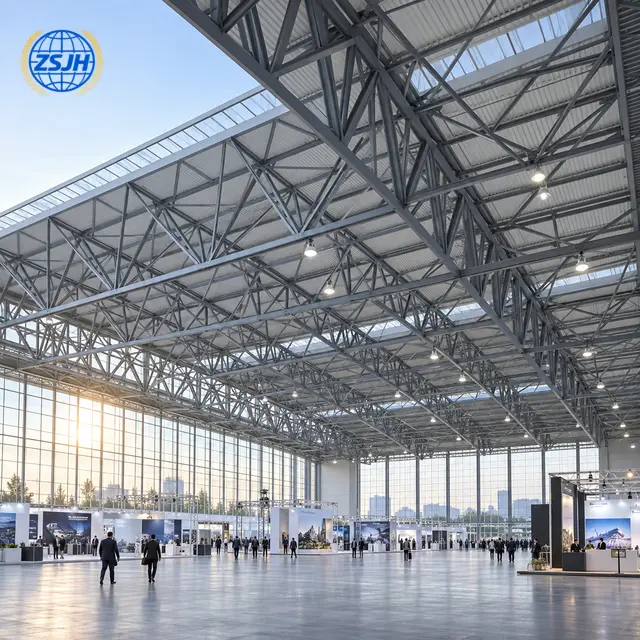
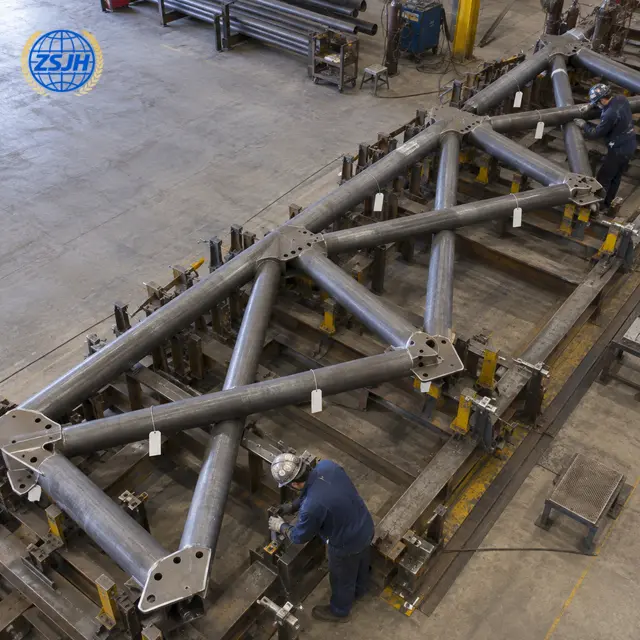
Trusses can incorporate deep upper and lower chords, diagonal and vertical web members, reinforced gusset nodes, splice connections and lifting attachments. Fabrication planning considers member geometry, welding access, overall camber, trial assembly and transport segmentation.
Individual sections are cut and prepared using controlled templates and fixtures. Node assemblies receive particular attention because they transfer concentrated forces between chords and web members. Long trusses may be manufactured in match-marked transport sections and trial assembled to confirm alignment before coating and shipment.
| Item | Available Options |
|---|---|
| Truss type | Roof, tubular, box-section, planar or three-dimensional truss |
| Member sections | Circular tube, rectangular tube, welded box or built-up sections |
| Delivery | Complete assembly or match-marked transport sections |
| Connection | Welded, bolted splice or combined |
| Finish | Primer, paint, galvanizing where suitable or specified coating |
Efficient structures for large column-free spans
Reinforced nodes for high load transfer
Camber and dimensional control during fabrication
Trial assembly and match-marked splice sections
Lifting and transport planning for oversized members
Industrial workshops, aircraft hangars, stadiums, exhibition halls, transportation terminals, warehouses, power plants and large public buildings.
Span, depth, member section, node geometry, splice position, camber, lifting points and coating are fabricated according to customer-approved drawings.
Drawing review → member cutting → edge preparation → node and chord assembly → controlled welding → straightness/camber checks → trial assembly → NDT → coating → segmented packing.
Provide your truss drawings, span, loads and delivery limits for a project-specific fabrication assessment.


